Roguelike vs Roguelite: The Difference, Explained
Store pages use the terms interchangeably. Reviewers use them interchangeably. Most players use them interchangeably, and the world keeps turning. But "roguelike" and "roguelite" describe two different design philosophies, and knowing which one you are looking at is useful for exactly one practical reason: it predicts whether you'll like a game before you buy it.
It starts with Rogue, obviously
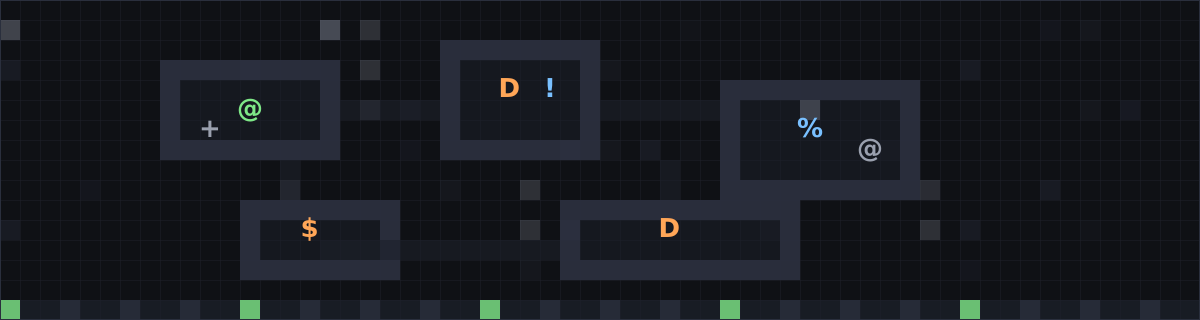
Rogue (1980) was a dungeon crawler for Unix systems, rendered entirely in ASCII characters: your hero an @, dragons a capital D. Its two defining ideas were that dungeons were procedurally generated, so no two games were alike, and that death was permanent. That second idea gets summarized as "no saves" — which isn't quite right. Rogue let you suspend a game and pick it up later, but the save file was erased the moment you reloaded it, which killed save-scumming and made death stick. That deletion-on-load convention is what the rest of the genre inherited.
Those two ideas were radical enough to spawn four decades of descendants, including NetHack, Angband and Ancient Domains of Mystery, each layering on simulation depth. NetHack in particular became famous for interactions so thorough that "the dev team thinks of everything" is a community proverb.
The strict definition of a roguelike
For purists, a roguelike is a game like those: turn-based, grid-based, procedurally generated, permadeath, and, critically, every run starts from zero. Your only persistent resource is knowledge. There was even a formal attempt to pin this down, the 2008 "Berlin Interpretation," drafted at the International Roguelike Development Conference in Berlin, which enumerated factors like turn-based play, resource management and complexity. Modern standard-bearers include Caves of Qud, Cogmind and the approachable Shattered Pixel Dungeon, which is developed in the open under the GPL. When you die in these games, nothing carries over. The game doesn't get easier; you get better.
How the dam broke
The word "roguelite" exists mostly because of three games. Spelunky, released as freeware in December 2008, showed that Rogue's structure of random runs and permadeath could be bolted onto a real-time action platformer. The Binding of Isaac (2011) turned that formula into a commercial phenomenon. Then Rogue Legacy (2013) made persistent progression the point rather than a side dish.
Isaac already had permanent unlocks: clear certain bosses or conditions and new items, pickups and playable characters get written into your save file for good. What Cellar Door Games did was build a whole structure around the idea. When your knight died, your heir inherited an upgraded Manor, meaning new classes, permanently higher stats, and unlocked blacksmith and enchantress NPCs, on top of whatever gear and runes you had already found. The castle you descend into is the one thing that doesn't carry over by default; it gets regenerated from scratch for every heir, unless you pay the Manor's architect to lock down a layout you have already seen. Death stopped being a reset and became a savings deposit. Purists needed a word for these games that wasn't "roguelike," and "roguelite" stuck.
The actual distinction, in one line
In a roguelike, the only thing that persists between runs is you. In a roguelite, the game itself remembers.
That's the load-bearing difference. Not graphics, not turn-based versus real-time (though purists care), but meta-progression. Hades is the clearest specimen: every death sends Zagreus home to spend resources on permanent upgrades and new weapons, and, most radically, to advance the story. Supergiant built a narrative engine where dying is the plot. It's a magnificent roguelite, and calling it a roguelike would mislead anyone who turned up expecting Caves of Qud.
Why the distinction predicts your taste
The two designs make opposite emotional promises. Roguelikes offer the purest difficulty curve in games: brutal, honest, entirely skill-and-knowledge based. A twenty-hour losing streak in a true roguelike means you have twenty hours of lessons; the win, when it comes, is entirely yours. Roguelites offer momentum: even a catastrophic run deposits something, so the game respects your time in a way roguelikes philosophically refuse to. Neither is superior — they're different contracts.
It is worth being precise here, because two very different ladders get filed under the same word. Balatro's eight Stakes are an ascension-style difficulty climb, tracked separately for each starting deck, where every stake stacks the penalties of the ones below it. Clearing one opens the next, harder rung of the climb. Hades' Mirror of Night and the cell-spent unlocks in Dead Cells do the opposite: they hand you power for showing up. Players who bounce off the first kind of climb often thrive on the second, and vice versa.
The blurry middle
Plenty of great games straddle the line. Spelunky has almost no meta-progression, shortcuts aside, but plays in real time, so strict Berliners exclude it while everyone else calls it a roguelike. Slay the Spire runs start from zero (mostly), but card unlocks between runs lean lite. Balatro is run-based and permadeath but entirely turn-based with no action component, which lands it in a third box neither word covers well. FTL, Into the Breach, Noita: the argument never ends, and that's fine. Genre labels are tools for setting expectations, not taxonomy exams. Even metroidvanias have this fight, and we drew our own lines in the metroidvania ranking.
Picking a first one
If you have played neither, Hades is the friendliest roguelite and Shattered Pixel Dungeon is the friendliest roguelike, with one caveat worth knowing before you go looking for it: it is free and open source on Android through Google Play and F-Droid, but the Steam and iOS builds are paid one-time purchases.
For the strict version of the genre, Caves of Qud and Brogue are the usual doors in, with NetHack waiting whenever you want the historical article. For run-based action that keeps handing you power, Dead Cells, Risk of Rain 2 and The Binding of Isaac. And if what appeals is a run-based game that is neither of those things, Balatro and Slay the Spire are turn-based and deck-driven, and better for it.